
How to cook fish on a griddle: fillets, steaks and whole fish
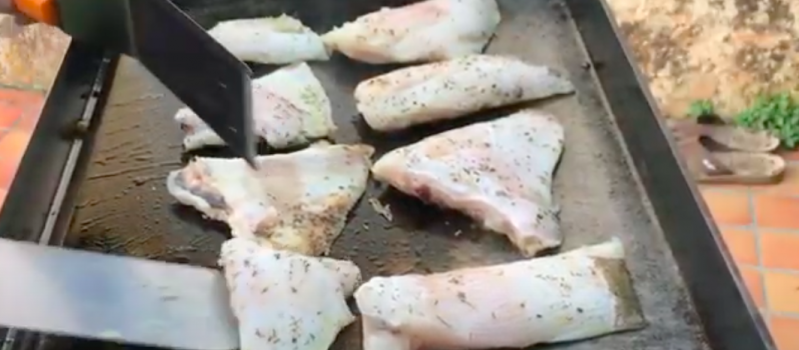
By Pierre-Henri Vannieuwenhuyse
Fish on the griddle deserves a little care – and rewards you with plenty of flavour!
Fish offers many possibilities in everyday cooking.

Depending on the species,
it can be lean or rich in omega-3 fats and provides protein. Serve it with spices, as small appetiser portions, a main course or a mixed seafood grill. Availability and price vary by species: choose good-quality fish and suitable preparation.
Understanding how fish cooks on the griddle
Fish has a more delicate structure than meat. Its connective tissue softens at lower temperatures, varying by species, so it generally needs gentler handling and a different cooking approach. Culinary texture temperatures are not the same as safe minimum cooking temperatures. You cannot cook every fish like a steak and each type of fish needs its own approach. Oily or lean, small or large, different fish react differently to heat.
One rule applies throughout : put the fish on a hot, lightly oiled plate and leave it alone until it is ready to turn . Turning too early can break it; waiting too long can dry or burn it.
Whole fish or fillets?
Bones put many people off, making skinless, boneless fillets convenient. Freshness and proper storage are crucial to flavour and texture. The chef particularly values cooking on the bone to preserve the flesh’s texture. Steaming or pan-frying are other options, but for this guide we favour whole fishwhen practical, with the griddle bringing out their flavour.
Managing the cooking
Technique depends on the cut: fillets with or without skin, whole fish or steaks cut through larger fish. Experience helps you choose the approach, but these principles offer a starting point.
Skin-on fillets cooked on one side

Salmon portion
Start around 240°C to brown the skin, then lower the heat to finish gently. Do not necessarily turn the fillet; a suitable dome for 1–2 minutes can help cook the top. This is one-sided, skin-on cooking , which leaves the upper flesh moist. The thicker the fillet, the gentler the finishing heat should be. Rare tuna or salmon is a separate preparation requiring suitable sourcing and handling; 40°C in the centre is not a general safety target. For normally cooked fish, the standard reference is 63°C at the centre.
Cooking on suitable cooking paper
Paper can reduce sticking and protect delicate fish such as halibut, sole, whiting and plaice. Use only paper rated for the actual plate temperature; do not assume standard baking paper tolerates 240°C. The barrier reduces direct browning and gives gentler cooking. Fillets cook more gently and brown less, while remaining easier to lift intact. Whether you prefer stronger grilled flavours is a matter of taste.
Fish steaks with the central bone
Cut large fish across the bone into steaks. This keeps the structure supported and can limit sticking. Use a reasonably hot plate. Around 230–240°C is the chef’s starting point, adjusted as cooking progresses.
Cooking whole fish

Turbot
Make light scores along the sides so heat reaches more evenly towards the backbone, begin around 230°C and turn after 6–8 minutes or longer for large 1–2 kg fish. Probe the thickest part, generally behind the head, lower the heat and cover with a suitable dome to finish.
Avoid unnecessary overcooking, while reaching the appropriate safe internal temperature; 63°C is the standard reference for normally cooked fish. Prolonged heat causes the flesh to lose moisture and become dry.
Good fresh fish and well-handled frozen fish can both work. Frozen fish should be thawed appropriately and dried before cooking; its moisture and texture may require adjustments rather than assuming every frozen fish is inferior.
Equipment
In addition to normal utensils, use a long 15–20 cm spatula and a probe thermometer. Suitable cooking paper can help lift fragile fillets intact. A small water spray is also useful for cooking vegetables alongside.
For especially delicate fillets such as plaice, small red mullet or trout, a parcel provides a gentler option.

Fish parcels on the griddle
Make the parcel with suitable cooking paper and reinforce outside with foil if needed, keeping the foil from direct food contact. Use materials rated for the cooking temperature. The parcel retains moisture and cooks gently on the plate.
A suitable marinade is another way to add flavour to fish.
Now explore our companion guide to meat on the griddle !
- John Dory